
Why Retailers Partner with Union Source for Private label product development solutions
Nov 10, 2026
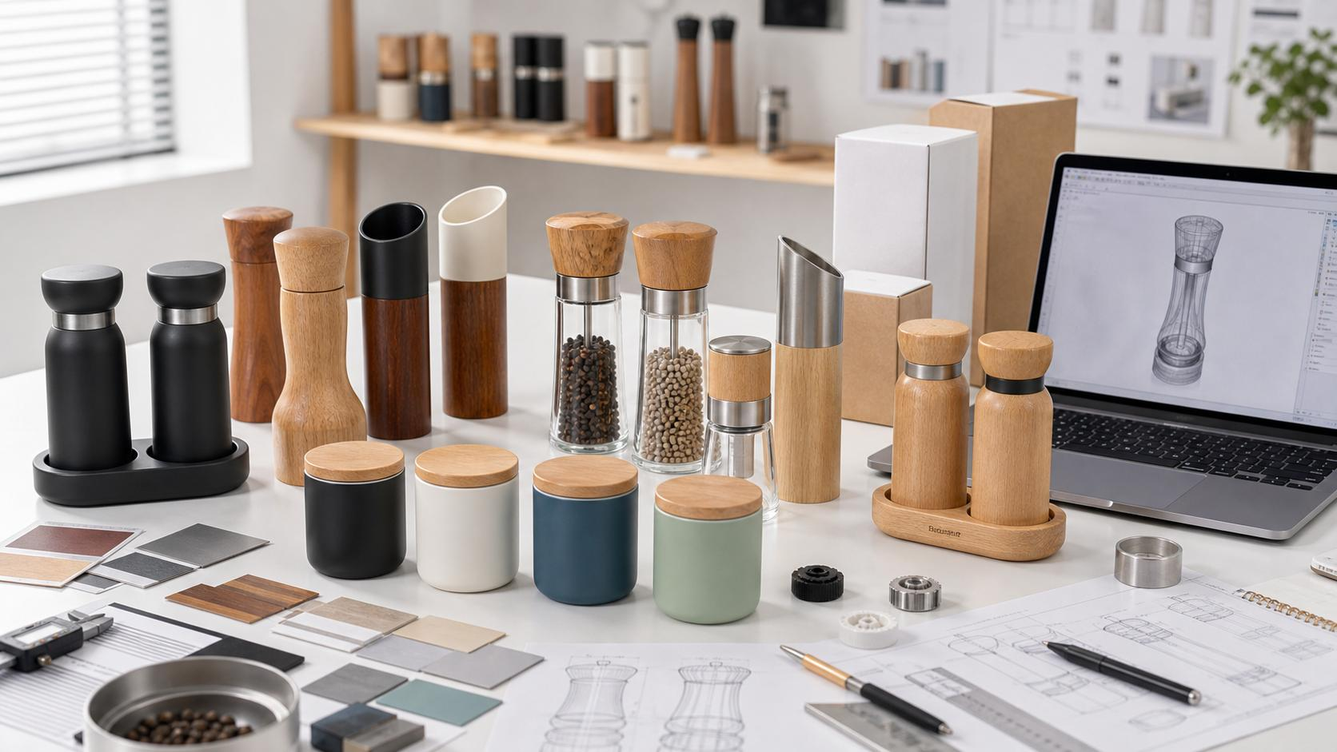
Ningbo, Zhejiang Nov 10, 2026 (Issuewire.com) - Building a private label program across high-traffic retail aisles requires far more than rebranding generic factory inventory. For supermarket chains, department stores, and multi-channel retailers, private brand expansion represents a strategic initiative to secure higher operating margins, strengthen customer loyalty, and deliver differentiated value against national brand competitors.
However, scaling private label merchandise across diverse consumer lifestyle departments introduces significant operational complexity. This process entails coordinating industrial design, color matching across varied production substrates, factory ethical audits, product safety certifications, and multi-supplier logistics synchronization. When sourcing directly from isolated manufacturing facilities, retailers frequently struggle with fragmented brand styling, high minimum order barriers, inconsistent quality standards, and disconnected supply chains.
To overcome these operational hurdles, international retail buyers increasingly partner with specialized product development and supply chain managers capable of managing the full merchandise lifecycle.
Here is an in-depth examination of why leading retailers partner with Union Source to engineer, manufacture, and deliver turnkey private label product solutions.
1. Cross-Category Merchandise Development Under a Unified Brand Identity
A primary operational obstacle in retail private label development is managing brand coherence across disparate manufacturing materials. A cohesive home or kitchen lifestyle collection typically combines molded plastics, brushed stainless steel, food-grade silicone, textiles, and natural bamboo.
Because individual factories specialize strictly in single materials or specific manufacturing processes, working directly with individual factories often results in mismatched Pantone shades, conflicting surface finishes, and disjointed retail presentation across the same product family.
An integrated development model resolves this through centralized visual and technical management:
Centralized CMF Specifications: Dedicated Color, Material, and Finish (CMF) specialists establish standardized color tolerances and surface texture parameters across diverse manufacturing substrates.
Unified Design Language: Industrial designers calibrate silhouette geometry, radius curves, and tactile grip elements across handheld tools, storage containers, and tableware, ensuring the entire collection looks and feels cohesive on retail shelving.
Streamlined Vendor Coordination: Sourcing teams manage the technical execution across distinct specialized factories, sparing the retailer from negotiating aesthetic standards separately with multiple suppliers.
2. Multi-Disciplinary In-House Engineering and Packaging Support
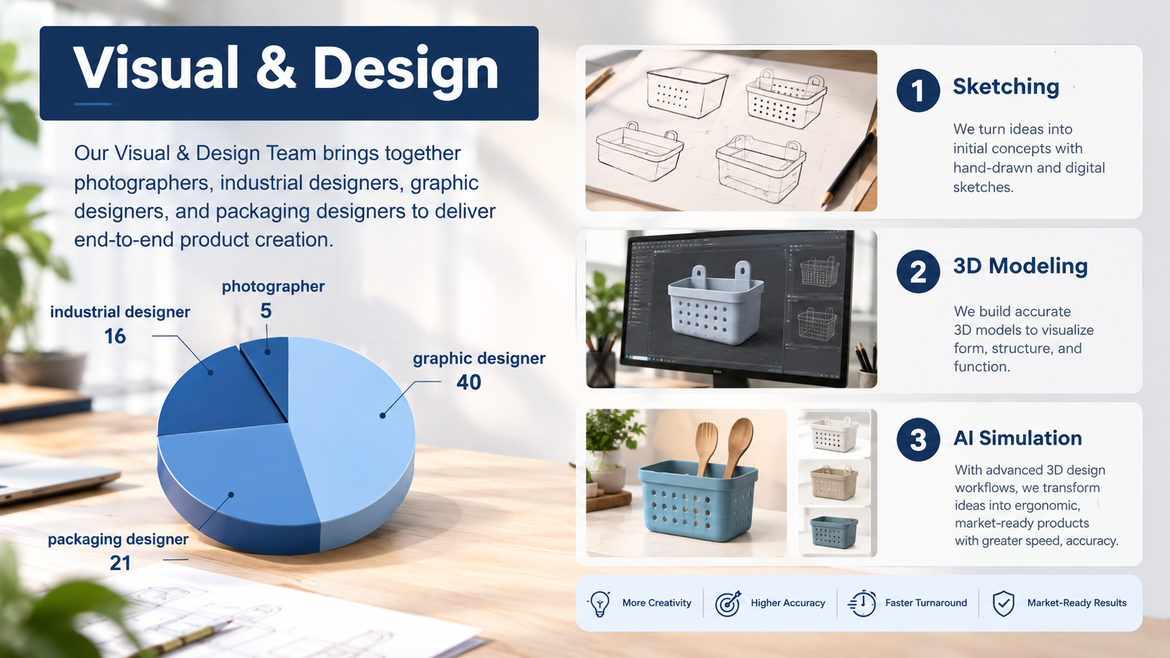
Turning retail merchandising concepts into shelf-ready inventory requires multidisciplinary technical capabilities. Rather than relying on third-party design agencies or factory-floor technicians, Union Source maintains a dedicated in-house design and engineering team structured to support the four essential pillars of private label development:
Industrial Design and Ergonomics: Designers focus on functional usability and regional consumer preferences. Anthropometric dimensions are calibrated for North American and European user hand spans, optimizing leverage, handle comfort, and balance across kitchen gadgets and personal care tools.
Structural Engineering and Tooling DFM: Engineers conduct Design for Manufacturability (DFM) reviews on custom part geometries. They verify wall thickness uniformity, internal rib structures, draft angles, and snap-fit tolerances, ensuring parts can be produced efficiently in automated injection and stamping lines.
Display-Ready Packaging (DRP): Packaging structural designers engineer retail-ready packaging formats, such as litho-laminated display boxes, tear-away master cartons, and sustainable sleeves. These structures allow retail store personnel to move goods directly from shipping cartons onto store shelves without unpackaging individual units, reducing store handling labor.
Packaging Compliance and Barcoding: Packaging teams ensure strict alignment with international retail standards, incorporating verified UPC/EAN barcodes, multilingual instructional copy, and required environmental recycling symbols.
3. De-Risked Category Expansion via Rapid Prototyping and Flexible MOQs
Entering new product categories or testing seasonal trend concepts presents retail inventory risks. Committing to large initial production runs before establishing customer purchase velocity can lead to margin-eroding clearance markdowns.
A structured private label partnership incorporates specific mechanisms to de-risk market testing:
Functional Physical Prototyping: For applicable lifestyle goods, functional engineering prototypes can be produced within 7-10 days using CNC machining, 3D printing, or vacuum casting. Sourcing merchants and category buyers can physically evaluate snap-fit action, volumetric capacity, and tactile feel during line reviews before authorizing capital expenditures for production tooling.
Flexible 1,000-Piece Trial Orders: For selected emerging programs, low-volume initial production orders starting around 1,000 units are accommodated depending on the product category. This allows retail merchandisers to test customer demand across several distinct colorways or secondary sizes with contained financial exposure.
Standardized 90-Day Production Roadmap: From final sample approval to container dispatch, projects follow a disciplined milestone schedule of approximately 90 days depending on project requirements, providing predictable lead-time visibility for seasonal assortment planning.
4. Comprehensive Retail Compliance and Multi-Stage Quality Assurance
Private label goods carry the retailer's brand name, meaning any product failure, toxic material incident, or factory labor violation directly damages the retailer's commercial reputation. Ensuring absolute compliance across hundreds of disparate factories requires continuous, multi-point verification.
A structured procurement framework establishes thorough quality safeguards:
Social and Ethical Factory Audits: Supplier matching protocols require production facilities to maintain valid ethical audit credentials, including BSCI, Sedex (SMETA), or ISO 9001 certifications matching the vendor compliance standards of major supermarket and retail chains.
International Product Safety Testing: Technical teams coordinate laboratory testing to verify compliance with mandatory destination market directives, including FDA 21 CFR and German LFGB for food-contact items, CE and RoHS for electrical goods, and REACH standards for chemical safety.
Standardized Quality Control Loop: Production undergoes structured inspection gates, including incoming raw material checks, during-production inspections (DUPRO) conducted when orders reach 20% to 50% completion, and final random pre-shipment inspections (PSI) conducted under international AQL Level II sampling standards (Major 2.5, Minor 4.0).
5. Multi-Supplier Consolidation and Port-Adjacent Mixed Container Shipping
One of the largest logistical inefficiencies in retail sourcing is shipping small, individual Less-Than-Container-Load (LCL) consignments from multiple independent factories. Multiple LCL shipments incur high destination port terminal handling charges, redundantcustoms clearance fees, and fragmented arrival schedules at retail distribution centers.
Consolidated logistics infrastructure turns multi-factory sourcing into an efficient supply stream:
Centralized 20,000 m² Consolidation Facility: Located near key maritime shipping hubs, goods from dozens of qualified manufacturing suppliers are received, verified, and staged under one roof.
Customs and Documentation Streamlining: Diverse product lines are consolidated into single, balanced maritime Full Container Loads (FCL). Sourcing specialists generate unified shipping documentation, including single bills of lading, harmonized tariff schedules, and consolidated commercial invoices.
Automated Palletization and Protection: Cargo is palletized according to specific supermarket warehouse criteria, utilizing ISPM-15 heat-treated pallets, corner edge protectors, and stretch-wrapping to minimize transit vibration and damage.
Frequently Asked Questions (FAQ)
How do retailers ensure color and finish consistency across products made in different factories?
Maintaining visual consistency across disparate factories requires centralized Color, Material, and Finish (CMF) control. Sourcing teams establish master Pantone physical swatches and precise gloss-level specifications to which all participating manufacturing facilities adhere. Pre-production color chips and sealed golden samples are verified against master standards using standardized spectrophotometers and optical light booths before bulk material processing begins.
What are the main advantages of mixed-container consolidation over direct factory LCL shipments?
Direct LCL shipments from multiple factories involve separate customs declaration fees, individual ocean freight surcharges, and costly destination de-consolidation fees at the arrival port. By aggregating merchandise into a single full container (FCL) at a centralized warehouse, retailers minimize redundant documentation fees, optimize shipping cube utilization, and coordinate seasonal product collections to arrive at retail distribution centers simultaneously.
How should a retailer balance initial prototype testing against production launch deadlines?
To balance thorough physical validation with strict retail seasonal deadlines, development teams utilize a stage-gate roadmap. Rapid functional prototyping takes place within 7-10 days for applicable designs, allowing immediate ergonomic and dimensional reviews. Once physical prototypes are confirmed, Design for Manufacturability (DFM) reviews run concurrently with packaging dieline engineering, compressing the overall timeline so that mass production and quality inspections fit cleanly within an approximate 90-day cycle depending on project requirements.
Working With Union Source for Turnkey Private Label Programs
Developing a resilient, highly differentiated private label portfolio demands seamless coordination between creative styling, precision manufacturing, strict compliance governance, and global consolidation logistics.
Union Source (https://www.unionsourceb2b.com/), established in 2005, operates as a comprehensive supply chain and product development partner for global supermarket chains, retail department stores, and independent brand owners. Supported by over 400 professionals, an audited network of 10,000+ manufacturing partners across more than 10 Chinese provinces, and a dedicated in-house design and engineering department, the organization delivers end-to-end OEM and ODM private label programs.
The company states that its integrated services cover trend analysis, industrial concept styling, 3D mechanical modeling, retail-ready packaging design, functional prototyping available in 7-10 days for applicable projects, factory social compliance auditing, and multi-supplier mixed container consolidation through its 20,000 m² modern warehouse facility.
By uniting product development, quality control, and export logistics within a single accountable operational interface, Union Source empowers retail organizations to scale distinctive, compliant, and commercially viable consumer goods collections with total supply chain transparency.
Media Contact
Union Source Co., Ltd.
+86 13967800390
21F, NO. 288 Guanghua RD. Ningbo National Hi-Tech Zone, Ningbo, China 315048
Source :Union Source Co., Ltd.
This article was originally published by IssueWire. Read the original article here.
More News

SpaceX Dragon returns to Earth with cancer research breakthroughs, 3D-printed blood vessels and more
SpaceX Dragon has returned from the ISS with cancer research samples, 3D-printed blood vessels and sleep-study equipment. The experiments could advance medical research and help NASA protect astronauts on future long-duration space missions.

All the signs that 'prove' Armageddon is on our doorstep: No one believed my warnings 12 years ago, but now all these prophecies are coming eerily true
Twelve years ago, a retired aerospace engineer published a study of a biblical prophecy which warned of terrible events in the Middle East - and which now seems to be coming true.

Scientists make astonishing discovery in the deepest place on Earth - and it could explain why the Mariana Trench plunges almost 7 miles beneath the waves
Scientists have made a baffling discovery on the flanks of this 6.8-mile-deep (10.9km) chasm that could explain why it plunges so far beneath the surface.

SpaceX Sued By Oregon and Virginia Over A.I.-Generated Sexualized Images
The states accused Elon Musk’s company of violating consumer protection laws with its Grok Imagine artificial intelligence tool, which created the images.

Apple may launch iPhone 18e, new MacBook Neo and iPads in early 2027: Here is what to expect from its product lineup
Apple is reportedly preparing several product launches for the first half of 2027, including the iPhone 18e, iPhone 18, new MacBook Neo and updated iPads. The company may split the launches across February, March and April.

Critical binary-parser Flaw Enables JavaScript Injection via Malicious Parser Definitions
A critical security flaw has been disclosed in the popular binary-parser library that could allow an attacker who controls parser definitions to execute arbitrary code. The vulnerability, tracked as CVE-2026-134814 (CVSS score: 9.2 / 8.1), is a case of code injection impacting binary-parser versions prior to 2.3.1. "Binary-parser before 2.3.1 contains a code injection vulnerability that allows

Earth 2.0? astronomers spot mysterious signs beyond Neptune
Astronomers Patryk Sofia Lykawka, Pedro Bernardinelli, and Jonti Horner have proposed Planet X2 which is a potential hidden planet out beyond the Kuiper Belt, distinct from the hypothesized Planet Nine.In a recent discovery beyond Neptune where sunlight is 900 times weaker than on Earth, certain...

Former Pentagon contractor claims aliens are living among us and 'taunting' US Navy to conceal chilling plan to repopulate Earth
Aliens are real, and they are taunting the US military with technology it cannot match, a former government weapons designer has claimed.

Breakthrough discovery could be proof Jesus rose from the dead... as new research uncovers hidden detail on ancient cloth linked to the Shroud of Turin
A discovery involving two of Christianity's most studied relics could finally prove that Jesus rose from the dead nearly 2,000 years ago.

Hackers Exploit Critical ScreenConnect Flaw to Hijack MSP Technician PCs Without Warning
Threat actors are exploiting a now-patched security flaw in ConnectWise ScreenConnect to target managed service provider (MSP) servers. The activity revolves around CVE-2026-84869 (CVSS score: 9.9), a critical ScreenConnect client flaw that allows a guest to transfer and execute a malicious payload on a connecting technician's host. "On November 12, 2026, we observed one managed service

N-able Discloses Critical Mail Assure Vulnerability Found During Breach Investigation
N-able yesterday disclosed a critical flaw it found while investigating the breach of its Mail Assure and SpamExperts Hosted Cloud, an email filtering service it runs for managed service providers. The bug, tracked as CVE-2026-134624, is a server-side request forgery (SSRF) flaw. It allowed a user with high-level API access to open connections to internal systems of the user's choosing on the
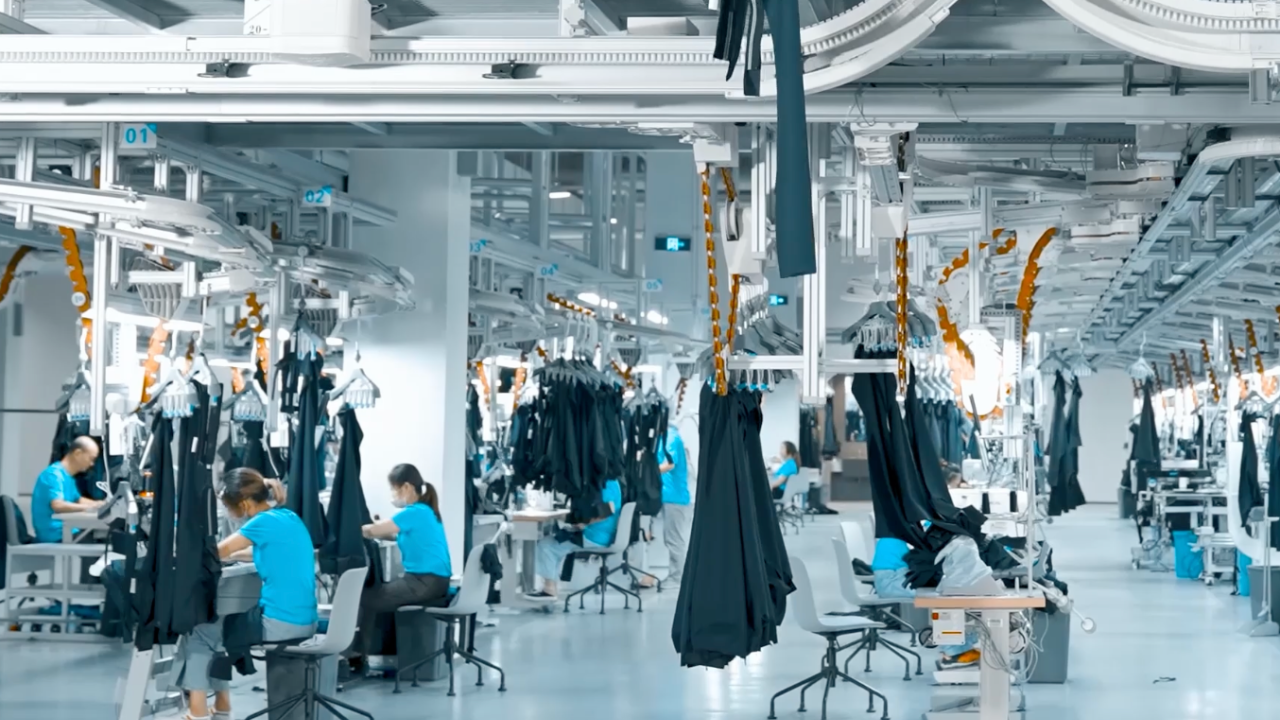
From steel to style: China’s ‘flagship’ AI factories move beyond heavy industry
Before a shirt reaches a shop in China, artificial intelligence may have already played a part in making it, from helping manufacturers understand consumer preferences to turning those insights into design ideas. At a factory run by Jiangsu-based HLA Group, AI-integrated systems work alongside human operators to coordinate production. The approach is gaining ground across China’s manufacturing sector, extending from heavy industry into consumer goods. On Thursday, the Ministry of Industry and...
Recommended


COP31 Climate Talks Broke Down. Now What?




YOUR NEWS, OUR NETWORK.
Do you have Great News you want to tell the world?
Be it updates about your business or your community, you can make sure that it’s heard by submitting your story to our network reaching hundreds of news sites across 6 verticals.