
Ginga Introduces AI-Powered Soccer Tracker Designed to Bring Performance Analytics to Every Player
Sep 28, 2026
Live on Kickstarter, Ginga is an Al-powered soccer tracker made for the players the sports-tech industry forgot.
Rome, Italy, September 28, 2026 -- Ginga, a new AI-powered wearable soccer tracker designed to bring performance analytics beyond professional clubs and elite academies, is currently live on global crowdfunding platform Kickstarter and raising funds to bring the technology to more players around the world.
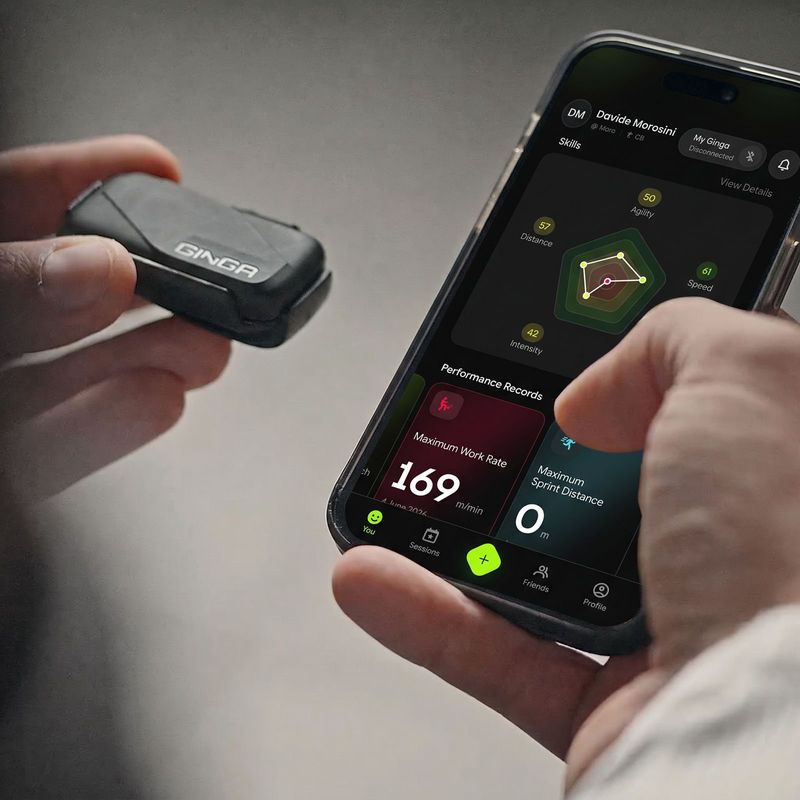
Designed for youth players, amateurs, coaches, and anyone who simply loves playing the game, Ginga combines a compact wearable sensor with on-device artificial intelligence to track a player's performance without requiring a GPS unit, special vest, harness, or phone on the pitch. The sensor clips directly to the waistband of a player's shorts and records movement throughout a session, allowing users to review 36 football-specific metrics, session highlights, and progress over time through the Ginga app.
“Real football doesn't live in professional clubs and elite academies. It's the most played game on earth, and it's born on village pitches, in the street, anywhere there's a ball and someone who wants to play,” says Marco Signorelli, founder and CEO of Ginga. “Ginga is our attempt to give some of that back, in the digital language kids actually speak today: your sessions, your matches, your stats and your highlights in one app that rewards you for playing more. Because the more time you spend with the ball, the better you get.”
Unlike many performance-tracking systems developed primarily for professional environments, Ginga was created to make detailed soccer analytics more accessible to everyday players and grassroots teams. Its 3D motion sensors process movement data at 100Hz, while Ginga's on-device AI analyzes each session and converts the information into football-specific performance metrics without relying on GPS.
Players can use the system indoors or outdoors and simply sync the device with the Ginga app after playing to review their performance. The platform is designed to help users understand areas including speed, agility, endurance, technical performance, and development over time, while giving coaches an additional way to monitor individual players and teams throughout a season.
Key Features of Ginga:
- 36 Soccer Performance Metrics — Tracks football-specific performance data across each training session or match.
- On-Device AI — Uses an integrated neural network to analyze movement and calculate performance metrics while the player is on the pitch.
- 3D Motion Tracking — Processes movement data at 100Hz without requiring GPS.
- Clip-and-Go Design — Attaches directly to the waistband of a player's shorts without the need for a vest, harness, or special equipment.
- 15-Day Battery Life — Designed to support extended periods of regular play between charges.
- Indoor and Outdoor Use — Works across different playing environments, including indoor football and five-a-side sessions.
- Progress Tracking — Allows players to review session history, highlights, and performance trends through the Ginga app.
- Designed for Players and Coaches — Gives individual players insight into their own development while providing coaches with additional performance information across a squad.
“The street is where you fall in love with the game, but the pitch with a coach on it is where you actually learn it: tactics, positioning, the biggest steps a player makes,” adds Signorelli. “Performance technology has existed for twenty years and it has been priced out of reach for the overwhelming majority of clubs. At Ginga's price, a youth coach can finally follow a whole squad and every individual in it: who is progressing across the season, who is overloaded, who is quietly getting better.”
Ginga's approach is built around making the technology as unobtrusive as possible. Rather than asking players to change how they train or play, the sensor is designed to remain clipped to their existing shorts while collecting performance information in the background. According to the company, this allows the technology to travel with players throughout their football journey, whether they are pursuing the game competitively or simply playing because they love it.
“Everything else asks you to change how you play: a vest, a camera on a tripod, someone to interpret the output for you. Ginga is one small sensor that lives with you,” says Signorelli. “What we're building is a digital layer that travels with you through your football life; whether you turn professional or play purely because you love it. It belongs to you, it grows with you, and you can share it with the people you play with.”
Ginga AI Soccer Tracker is currently live and available to support on Kickstarter: www.kickstarter.com/projects/ginga/ginga-the-ai-soccer-tracker-built-for-everyone
About Ginga
Ginga is an Italian sports-technology brand building performance analytics for the people who make up the overwhelming majority of players and the coaches who develop them. We are on a mission to bring soccer analytics to your backyard.
For more information on Ginga, please visit gingatracker.com.
###
Contact Info:
Name: Mark Winters
Email: Send Email
Organization: Ginga
Website: https://gingatracker.com/
Release ID: 89204519
In case of identifying any problems, concerns, or inaccuracies in the content shared in this press release, or if a press release needs to be taken down, we urge you to notify us immediately by contacting [email protected] (it is important to note that this email is the authorized channel for such matters, sending multiple emails to multiple addresses does not necessarily help expedite your request). Our dedicated team will be readily accessible to address your concerns and take swift action within 8 hours to rectify any issues identified or assist with the removal process. We are committed to delivering high-quality content and ensuring accuracy for our valued readers.
More News

RatHat Android Malware Console Uses Gemini to Identify Higher-Value Victims
RatHat's operators build and publish the Android banking trojan and control infected phones from a web console, according to security company Cleafy. Cleafy has traced nearly 100 deployments of that console since April 2026. It said this fits a malware-as-a-service model, in which each customer runs a separate copy. The console stores what the malware collects from each phone,

SpaceX sends giant Starship into orbit for the first time but ends the flight early
SpaceX launched its enormous Starship into orbit for the first time Monday and successfully delivered the most advanced Starlinks yet, but decided to cut short the flight.

This Virus Stole a Human Gene and Won’t Let Go of It
Scientists have found a human gene lurking in a virus that causes skin infections. It may be using our own DNA to infect us.

⚡ Weekly Recap: $387M Crypto Hack, Citrix Exploits, AI Agents Go Off-Script, and More Threats
A domain used as harmless placeholder text showed up in roughly 1,700 repositories. Then somebody registered it and started serving malicious lures. That is the kind of week this was: forgotten assumptions turning into live attack surface. Elsewhere, weak service accounts, old bugs, exposed systems, phishing kits, and strangely easy exploit paths kept doing useful work for attackers. Nothing

Watch: SpaceX launches Starship rocket into orbit for first time
Until now, all Starship flights have been suborbital, meaning the capsules did not complete a loop around the Earth.

Say goodbye to brown bananas! Gene-edited fruits could soon be sold in UK supermarkets
Experts at Tropic Biosciences, a UK company based in Norfolk, used a technique known as CRISPR-Cas9 to edit three genes that cause bananas to brown.

SpaceX Starship Flight 14 reaches orbit after successful insertion burn
SpaceX Starship Flight 14 reaches orbit in historic mission SpaceX launched its unprecedented Starship Flight for its first-ever orbital mission on Monday. The Super Heavy rocket booster just fired up its 33 rocket engines, giving the first burst of power off the launchpad. The launch took...

New hotel reservation analysis raise questions about guest experience and lost revenue opportunities
Lobby, the Artificial Intelligence (AI) platform that automates complex booking operations across suppliers of travel, hospitality and experiences, has carried out several analysis of reservation workflows that reveal a consistent pattern and challenge some common assumptions within hospitality. For years, hotels have focused on reducing reservation response times and on increasing conversion rates, as well as operational efficiency. According to Lobby’s analysis, the actual weaknesses in this part of the process are related to information, guest intent and the commercial opportunities lost between request and booking.

Siri Co-Creator to Open New Paris Forum Tackling AI’s Impact on the Traveller Journey
The world is not moving towards a single artificial intelligence future. The United States, Europe, China, the Middle East and India are developing distinct systems shaped by different approaches to innovation, sovereignty, trust, data and scale. On 28 and 29 October, the Global Resilience Network (GRN) will bring those five pathways into one room at the Global Travel Futures Forum in Paris and test what they mean in practice for the global travel economy.

Crows are being given naloxone after suspected drug overdoses in Prince George
The increased toxicity of the illicit drug supply has prompted public warnings in the north-central B.C. city.

Webinar: How to Govern AI Agents, Reduce Excessive Access, and Control Shadow AI
AI agents are moving into production faster than security teams can govern them. They are connecting to apps, handling data, calling APIs, and acting across business systems—often without the same controls applied to human users. According to Okta’s Global CISO Insights 2026 report, only 47% of CISOs are confident they can identify every AI agent in their environment. Even among those who feel

Carbonato Botnet Compromises Docker Hosts to Deploy Telegram-Controlled Hermes AI Agent
Cybersecurity researchers have disclosed details of a new botnet malware called Carbonato that's targeting exposed Docker daemons to deploy an open-source artificial intelligence (AI) agent framework called Hermes Agent. "The implant installs the framework unchanged, then overwrites its SOUL.md persona file," ThreatDown said. "The 39-line prompt directs it to execute tasks received through
Recommended


YOUR NEWS, OUR NETWORK.
Do you have Great News you want to tell the world?
Be it updates about your business or your community, you can make sure that it’s heard by submitting your story to our network reaching hundreds of news sites across 6 verticals.