
FLock.io Launches Qwen-powered, Open-Source Decision Model for Local Edge Deployment
Oct 16, 2026
Built on Qwen3.5-2B, FLock.io and Oxford University researchers have launched an open-source AI decision model that outperforms Jev and larger LLMs in various benchmarking tests and can be deployed on local hardware to protect data privacy.
London, England, United Kingdom, October 16, 2026 -- FLock.io, a developer of privacy-preserving AI infrastructure, has launched THIS/THAT Model: an open-source, lightweight “System One” decision model built on the Qwen3.5-2B foundation model. It can be run locally, ensuring data sovereignty. It was developed with researchers from the University of Oxford and with the support of Alibaba Cloud.

The launch joins a wave of decision models that have been released in recent weeks, which provide a low-cost, small, high-speed alternative to chatbots where generating text is unnecessary. Designed for enterprise tasks that require structured choices rather than open-ended text generation, it has already processed 2.5 million decisions three weeks after going live. TypeSafe’s Jev popularised the concept, alongside OpenAI’s Decisions API, Microsoft-Decision-1, and open-source options like Cloudflare’s Clef.
THIS/THAT can be deployed locally for full data privacy and sovereignty
Setting THIS/THAT apart is how it is not only open-source, but also small enough to run on your own device, whether it is a laptop, smartphone, hospital gateway or rugged field tablet in a warzone. The 1.9-billion-parameter model requires no central GPU servers and no cloud connectivity. By executing decisions locally, it ensures sensitive data never leaves the user’s machine.
For regulated sectors such as governments, banking institutions, and healthcare providers, relying on centralised cloud LLMs introduces significant data security risks and regulatory hurdles. Unlike hosted alternatives, THIS / THAT Model guarantees total data sovereignty: no enterprise data is ever transmitted to OpenAI, Microsoft, Cloudflare, or third-party servers.
Jiahao Sun, CEO of FLock.io, said: “For many critical enterprise tasks, generating open-ended text is a performance bottleneck and an unnecessary cost. With THIS / THAT Model, we have demonstrated that specialised 2B-parameter models running on local devices can outperform huge cloud LLMs in accuracy, cost-efficiency and speed– all while keeping data on-device.”
The benchmarking results
In third-party evaluations, version 1.2 achieved 94.1% accuracy versus TypeSafe Jev’s 76.5% on 68 local-geometry questions; 87.8% success rate on laptop-based benchmarks, outperforming Claude Opus 5’s 83.4%. In budget-constrained optimisation, its success was 4x that of GPT-5.6 and 5x Claude Opus 5. This was a rapid improvement from 1.0’s tests just a day before, achieved through optimising training data rather than increasing model size. It drastically reduces compute and latency bottlenecks compared to cloud-hosted LLMs.
See the latest benchmarking on Hugging Face: https://huggingface.co/flock-io/this-that-model-1.2
Source code repository: https://github.com/FLock-io/this-that-model
Decision models address the LLM compute and latency bottleneck
Enterprise AI is witnessing the emergence of “System One” decision models, a specialised class of models. While conventional LLMs auto-regressively generate open-ended text, decision models process queries over predefined answer spaces (such as binary or categorical choices). Borrowed from Daniel Kahneman’s psychological framework, “System 1” represents fast, automatic pattern execution, contrasting with the slow, effortful “System 2” reasoning performed by generative chatbots like ChatGPT.
It addresses a core problem faced by AI agents’ workflow, which involves thousands of routine micro-decisions, such as approving transactions. Relying on general-purpose cloud LLMs for these deterministic tasks creates severe operational bottlenecks. They have high latency, with generating text token-by-token taking seconds per query. Token overhead is high, with hidden prompt-processing costs accumulating rapidly over millions of API calls. Apps must also continually clean and validate the text.
THIS / THAT Model’s technical specifications
THIS/THAT was built on Qwen3.5-2B: a tiny, edge-friendly foundation model that can be run locally on laptops and smartphones. It is lightweight, with only 1.88B parameters (less than an estimated 0.04% the size of Claude Opus 5) and zero generated output tokens. The local inference latency is ultra low, at approximately 31.4 milliseconds, compared to standard LLMs taking seconds. It was trained on Alibaba Cloud using synthetic training data generated using Qwen Max. It drew on key findings from FLock.io’s recent research papers, GraphSynth and CircuitSynth, which were accepted into the prestigious ACL 2026 conference.
About FLock.io
FLock.io is an AI research and infrastructure company pioneering enterprise-grade federated learning and distributed AI solutions. Its decentralised federated learning architecture and production-ready platforms (AI Arena, FL Alliance, FOMO and the API Platform) enable organisations to train and deploy their own custom AI models on local hardware while maintaining full data privacy, model ownership, and regulatory alignment by design.
Qwen, a tier 1 LLM developed by Alibaba Cloud, partnered with FLock.io in April 2025. It marked the first time a major Web2 centralised LLM has chosen to deeply integrate with a decentralised training platform.
Website: https://www.flock.io/
Media contact:
Phoebe Hennell
London
Contact Info:
Name: Sheharyar Khan
Email: Send Email
Organization: HackerNoon
Website: https://hackernoon.com/
Release ID: 89206434
In the event of encountering any errors, concerns, or inconsistencies within the content shared in this press release, we kindly request that you immediately contact us at [email protected] (it is important to note that this email is the authorized channel for such matters, sending multiple emails to multiple addresses does not necessarily help expedite your request). Our dedicated team will be readily accessible to address your feedback within 8 hours and take appropriate measures to rectify any identified issues or facilitate press release takedowns. Ensuring accuracy and reliability are central to our commitment.
More News

Urgent warning to parents over baby swim floats sold on Amazon, eBay and Vinted - as they could put children at risk of drowning
Experts have issued an urgent warning to parents over hundreds of potentially dangerous swim floats being sold by major online marketplaces.

'This is a prank, right?' Social media is baffled by Tesla's flying car stunt - as one jokes 'car insurance companies are going to s*** themselves'
Elon Musk has shocked the world by unveiling a spectacular demonstration of a new Tesla flying car. However, on social media, tech fans have been left baffled by the outlandish stunt.

NASA's next Mars mission targets Phobos and Deimos, not Red Planet
NASA’s next Mars mission targets Phobos and Deimos, not Red Planet This is no secret that most of NASA’s missions revolve around finding Mars’ ancient secrets. But this time something different is going to happen. This time, NASA is backing a mission named JAXA’s...

What is behind the success of dark skies festival?
Stargazers are preparing to enjoy an annual festival that celebrates the beauty of the night sky.

Tesla Debuts 2026 Roadster, an EV Sports Car at Least $200,000
Elon Musk’s company and other automakers, like Jaguar and Bentley, are trying to sell very expensive electric cars to people who usually prefer gasoline-fueled luxury and performance.

Citizen Science Groups Grapple With the Rise of A.I. Slop
Facing a flood of A.I. slop, groups bent on democratizing science create new checks and balances.
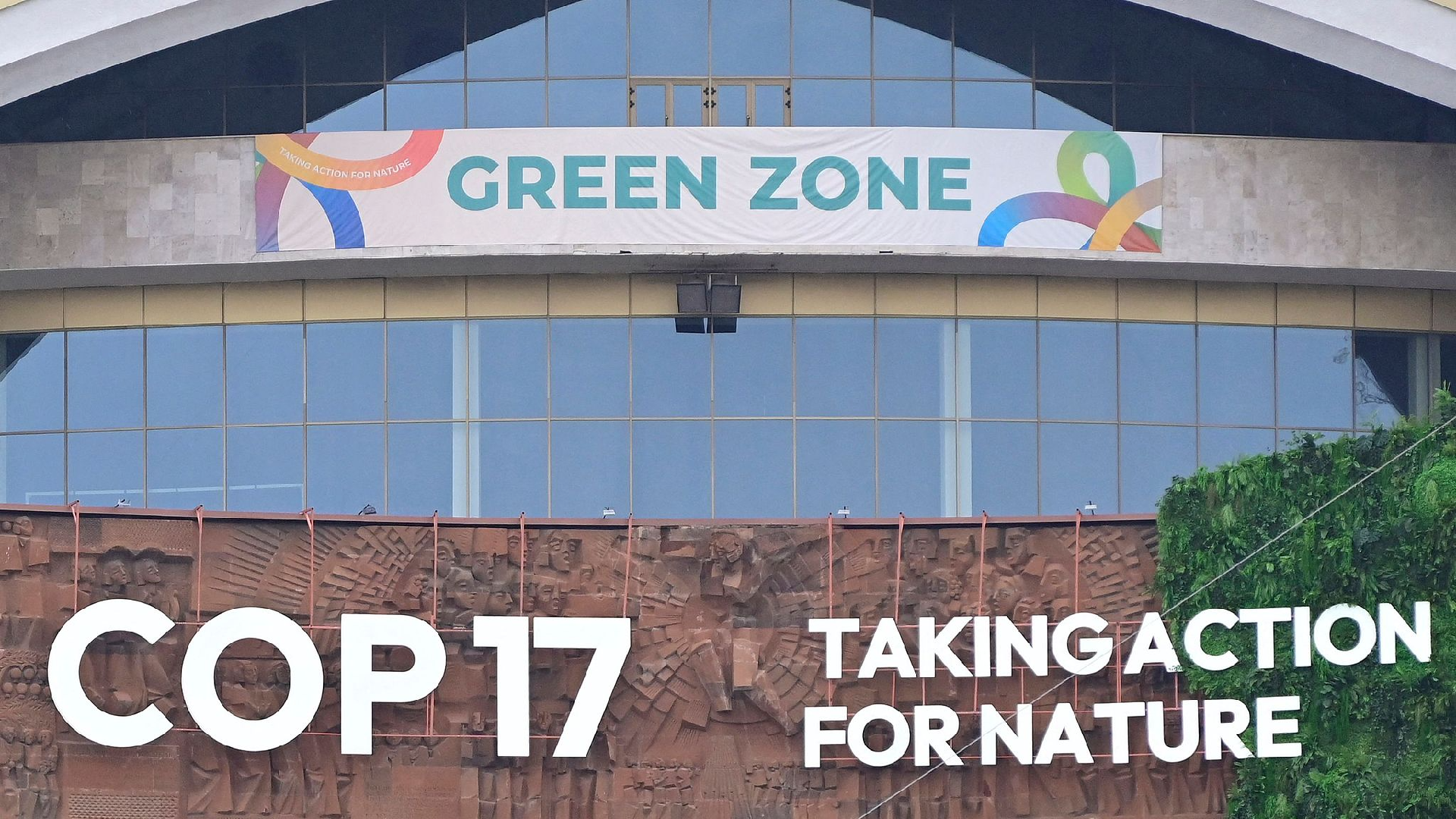
UN warns global biodiversity action off track, urges implementation
UN warns global biodiversity action off track, urges implementation

Is AI ready to rewrite our understanding of physics?
Is AI ready to rewrite our understanding of physics?Physicists went through 250 answers that AI models got "wrong" on physics benchmarks. Only 12 were genuine physics errors by the model.That's the headline result of a 2026 preprint from Yale University researchers and colleagues, who re-graded...

Apple iPhone Duo pre-orders begin in India today: Check prices, storage variants and offers
Apple iPhone Duo pre-orders begin in India at 5:30 PM IST on October 16, 2026, with sales starting October 23 at prices from ₹2,99,900. The foldable smartphone features a 7.6-inch inner display, a 5.4-inch outer screen, the A20 Pro chip and a 48MP dual rear camera system.

What is ArtCraft? Free AI-built software offers alternatives to Adobe Photoshop, Premiere Pro and more
ArtCraft is a free, open-source software suite launched in October 2026 by developer Brandon Thomas, offering AI-assisted alternatives to Adobe Photoshop, Premiere Pro and Microsoft Office apps.

Astronomers identify possible first green star in 27 years of research
Astronomers identify possible first green star in 27 years of researchYou'd expect a dead star to look white, and roughly 29 in 30 white dwarfs do. A team at the University of Warwick says the rest can glow pink, purple, yellow, cyan or even green. One of them may be the first green star anyone...

Chinas Tencent says AI agents showed unintended browsing behaviour
AI-SAFETY/CHINA-TENCENT (PIX):China's Tencent says AI agents showed unintended browsing behaviour
Recommended


Why No One Can Look Away From Elizabeth Holmes




YOUR NEWS, OUR NETWORK.
Do you have Great News you want to tell the world?
Be it updates about your business or your community, you can make sure that it’s heard by submitting your story to our network reaching hundreds of news sites across 6 verticals.